
 Free Delivery & Return
 365-Day Returns
 10 Million Happy Customers
 500,000 Products in Stock


Chairs (1.593)


Chairs

A chair is one of the most-used pieces of furniture in any home, moved, sat in and pulled out more often than almost anything else you own. The right one depends entirely on where it will live: a dining table, a kitchen counter, an outdoor terrace or a multipurpose room all call for a different balance of comfort, material and build. This page covers how to match a chair to its setting, pick a material that will hold up, and choose the features that make daily use easier.
In short
Which chair is right for you?
Match the chair to where it will be used, then to the material that suits that setting. A dining chair needs a seat height of around 45-48 cm to clear a standard 74-76 cm table, a counter stool needs a 60-70 cm seat, and a bar stool needs 73-78 cm; always check this against your own table or worktop rather than assuming. Beyond height, choose a hard-wearing, easy-clean material for daily or outdoor use, and consider stacking, folding or swivel features if the chair needs to save space or move often.
- Where the chair is used (dining, bar, outdoor, multipurpose) sets the required height and material
- How often it is moved or stored changes whether stacking or folding matters
- Indoor versus outdoor use determines how weather-resistant the material needs to be
Which type of chair suits your space?
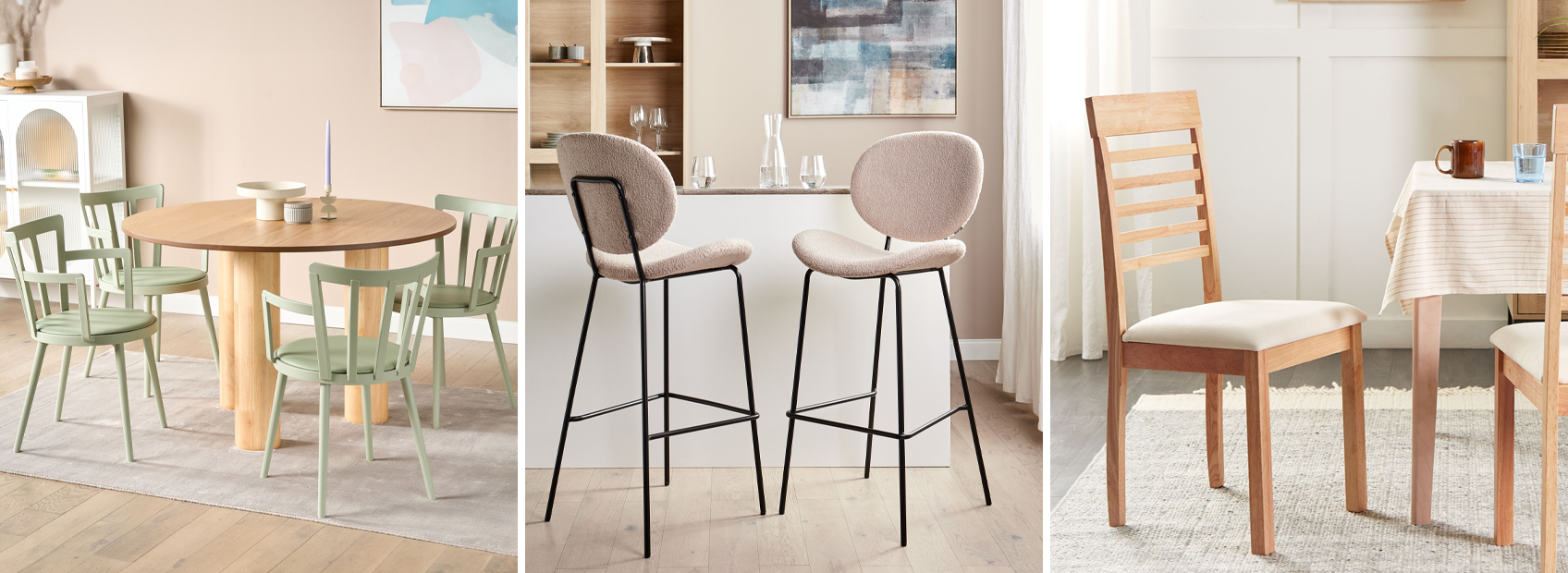
Chairs are usually chosen around where they will sit rather than how they look first. Matching the type to the setting gets the height, build and material right from the start.
- Dining chairs: built for comfortable, padded seating at a table, with a seat height of around 45-48 cm to clear a standard 74-76 cm dining table
- Bar chairs and stools: sized to match the worktop, with counter stools around 60-70 cm and bar stools around 73-78 cm; many tuck under the counter when not in use, which saves space in smaller kitchens
- Banquet chairs: stackable, sturdy and easy to clean, built for events and multipurpose rooms where chairs need to be stored quickly between uses
- Garden chairs: made from weather-resistant materials for outdoor terraces and patios, often lightweight enough to move with the sun or store away in winter
- Rocking chairs: a gentle, repetitive motion that suits nurseries and relaxed living spaces, used as a dedicated seat rather than an everyday dining or desk chair
- Hanging and cantilever chairs: a suspended or sprung frame instead of four fixed legs, chosen mainly for a distinctive look and a different kind of seated movement
Shop now: dining chairs, bar chairs and stools, banquet chairs and garden chairs
What extra features can a chair offer?
Beyond the basic shape, several features change how practical a chair is for daily use, especially in a busy household or a room that serves more than one purpose.
Mobility
Swivel base
A 360-degree swivel lets you turn towards different parts of a room without moving the chair. It is useful for bar stools, home-office chairs and open-plan living spaces.
Space-saving
Folding and stacking
Folding chairs collapse flat for storage, while stacking chairs pile on top of each other. Both are ideal for events, small kitchens or any room that needs extra seating only some of the time.
Support
Footstool or footrest
Raising your feet can make longer sitting sessions more comfortable. A separate footstool can also double as extra seating when it is not in use.
Adjustability
Adjustable height
Often a gas-lift mechanism, this lets you raise or lower the seat so one chair can suit different users, tables and worktops. It is most useful for bar and counter stools, where the right seat height depends on the surface. Check the minimum and maximum height against your worktop, as the range varies by model.
Which material suits your needs?

Chair materials range from hard-wearing and weatherproof to soft and purely decorative, and the right one depends on where the chair will sit and how often it will be used.
| Material | Feel and look | Best for | Maintenance |
|---|---|---|---|
| Solid wood | Timeless look, sturdy build, natural grain variation | Long-term daily use; supports significant weight and resists wear over time | Dust regularly; wipe with a barely damp cloth and keep away from direct heat |
| Engineered wood | Similar look to solid wood at a lower price point | Budget-conscious daily use indoors | Wipe with a dry or barely damp cloth; avoid prolonged exposure to moisture |
| Fabric | Soft, breathable, wide range of colours and patterns | Dining and living spaces where comfort matters more than wipe-clean ease | Vacuum regularly; spot clean following the care label |
| Leather | Smooth, structured, develops a natural patina over time | Long-term daily use and households wanting a material that ages well | Wipe clean; needs occasional conditioning to prevent cracking |
| Faux leather | Same smooth, structured look as real leather, more uniform finish | Households with children, since spills wipe off easily | Wipe clean; no conditioning needed, but less breathable than real leather |
| Rattan | Lightweight, woven look; natural rattan suits indoor spaces, while synthetic (PE) rattan is made for outdoors | Easy rearranging; synthetic rattan is the durable choice for gardens and patios | Wipe down; keep natural rattan indoors, and cover or store outdoor rattan in bad weather |
| Metal | Sturdy, modern look, often with a protective coating | Outdoor use and high-traffic indoor settings needing long-term durability | Wipe clean; check coating periodically on outdoor pieces for rust spots |
| Plastic | Versatile, often mimics natural materials, water-resistant | Outdoor use and households with children, thanks to low maintenance | Wipe clean with soapy water; resistant to most everyday stains, but can fade in strong sun |
Shop now: wooden chairs, fabric chairs, rattan chairs and plastic chairs
How do you care for different chair materials?

Most chair materials only need a quick routine, and the method that works best depends on what the chair is made from.
- Solid and engineered wood: dust regularly and wipe with a barely damp cloth; avoid placing chairs near direct heat sources, which can dry out and crack the finish
- Fabric: vacuum with an upholstery attachment and blot spills immediately rather than rubbing them in
- Real leather: wipe weekly with a dry or barely damp cloth, and condition every 6 to 12 months to stop the surface from drying out
- Faux leather: wipe with a damp cloth and mild soap; avoid solvent-based cleaners, which can damage the coating
- Rattan: dust and wipe with a slightly damp cloth; keep natural rattan indoors, and bring outdoor rattan in or cover it during wet or very sunny weather
- Metal and plastic: wipe with soapy water; dry outdoor metal after heavy rain and touch up any chipped coating promptly to prevent rust, and shade plastic from strong sun to limit fading
On fabric chairs, a fabric protector spray applied when the chair is new (tested on a hidden area first) adds a layer of stain resistance. Whatever the material, acting on a spill straight away makes the biggest difference to whether a mark comes out.
What to check before buying
Before you commit to a chair, run through this checklist.
- Seat height against your table or worktop: around 45-48 cm for dining, 60-70 cm for a counter, 73-78 cm for a bar
- Enough width per person around the table, roughly 60 cm each
- Clear space behind the chairs, around 90 cm between the table edge and the nearest wall or furniture, so chairs can be pulled out and people can pass
- Whether the chair needs to stack, fold or swivel for how the room is actually used
- Weather resistance if the chair will spend any time outdoors
- A fabric or finish that matches how often the chair will be used and cleaned
- Weight capacity and stability if the chair will see heavy daily use or events
Learn more: how to find the perfect dining room chair
Frequently asked questions
How many dining chairs do I need for my table?
Allow around 60 cm of width per person along each side of the table, then check this against the table's actual length and width. For example, a table around 180 cm long comfortably seats six, with three chairs along each long side. Also leave space behind the chairs so they can be pulled out.
What is the difference between a bar stool and a counter stool?
A counter stool has a seat height of around 60-70 cm, matching a kitchen counter of about 90-95 cm. A bar stool sits higher, around 73-78 cm, to match a bar-height surface of about 105-110 cm, so the two are not interchangeable without checking your worktop height.
Are stacking chairs strong enough for everyday use?
Generally yes. Well-made stacking chairs are designed for repeated handling and stacking, so strength is rarely the issue. What varies is comfort, since many have slimmer seats and less padding than a dining chair. For daily use, choose a padded model and check the weight capacity and frame material.
Is solid wood always better than engineered wood for a chair frame?
Not necessarily. Solid wood is more durable long-term and can be repaired or refinished, but engineered wood is more affordable and resists warping from humidity changes better in some cases. Choose solid wood for a chair that needs to last decades, and engineered wood when budget matters more than longevity.
Can outdoor chairs be used indoors?
Yes, in most cases. A chair made for outdoor use is built to cope with moisture and sun, so it works well in a dry indoor space, though outdoor chairs often have less padding and a more utilitarian look, so check comfort and style. The reverse is not true: an indoor-only chair should not be left outside or exposed to rain.