Free Delivery & Return
 365-Day Returns
 10 Million Happy Customers
 500,000 Products in Stock

Extendable Dining Tables for Hosting and Everyday Life
Reviewed by the Beliani Content Team · Updated October 2026
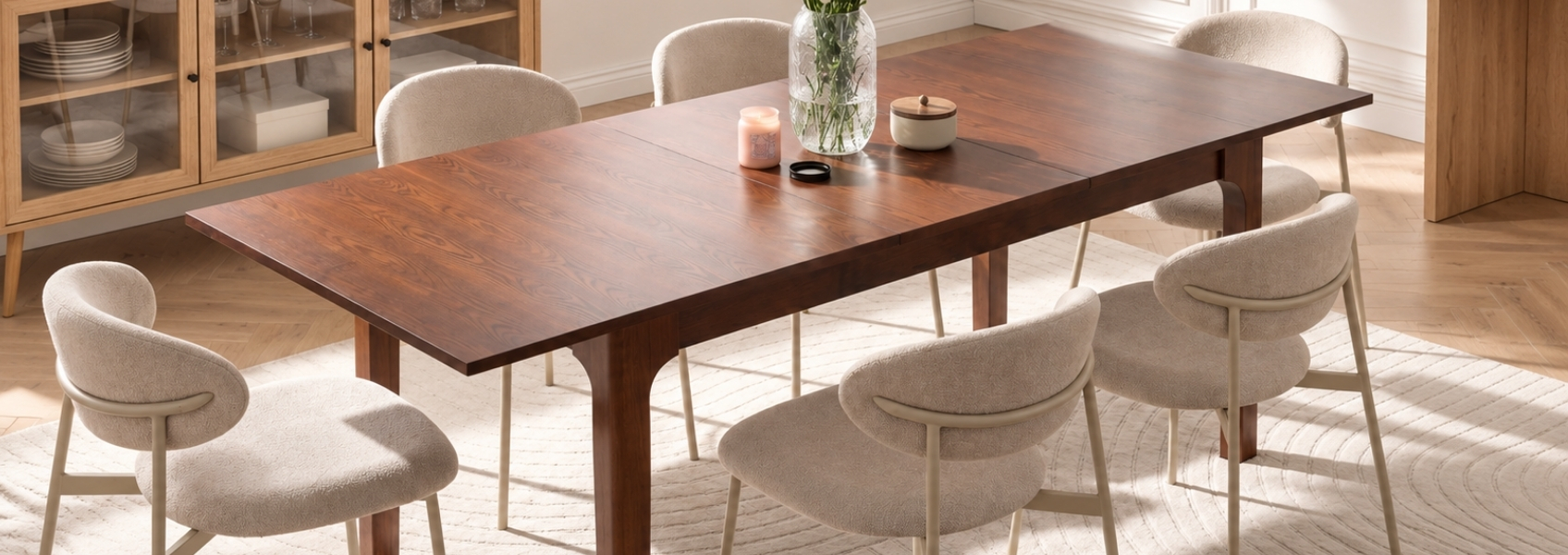
Unless you're hosting your whole family every night, the dining table rarely needs to be a large size. Most evenings it seats two to four people for a quick dinner, then once or twice a month it has to welcome more people for a birthday party or a late Sunday lunch. An extendable dining table handles both, so your room doesn't have to give up floor space all year round for a table sized for the occasional feast.
In short
How much bigger does an extendable dining table get?
A typical extendable dining table grows by 50 to 100 cm once its leaf (or leaves) is added, which is usually enough to go from seating four to six, or six to eight. The exact gain depends on a few things:
- How many leaves the table has: one leaf adds less length than two
- Whether the leaf stores inside the table or has to be kept elsewhere
- How big the table is to begin with, since a larger table needs more room around it once it's extended
One table for everyday meals and bigger gatherings
Shop the look
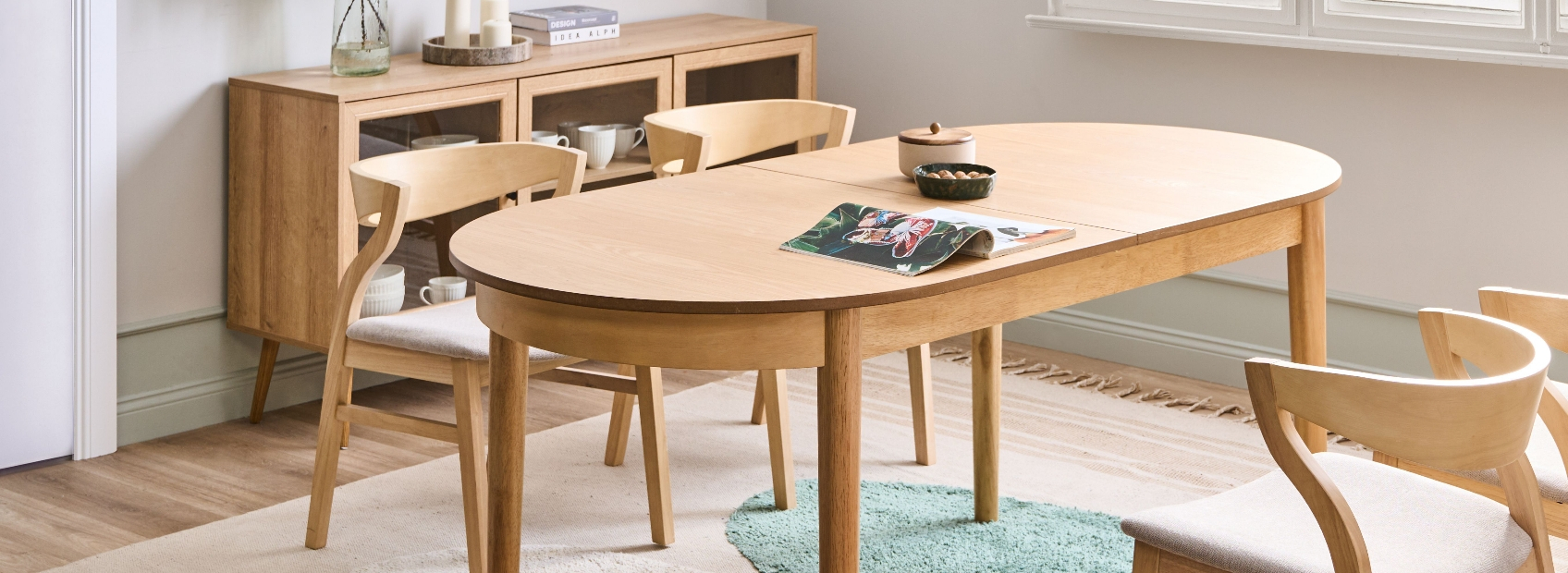
Flick between the two sizes to see how an extendable dining table keeps up with your day.
Everyday
Compact for daily life
4 seats
Keep the table closed for weekday dinners, homework and working from home. It takes up less floor space, so you can actually move around the room.
Shop the look
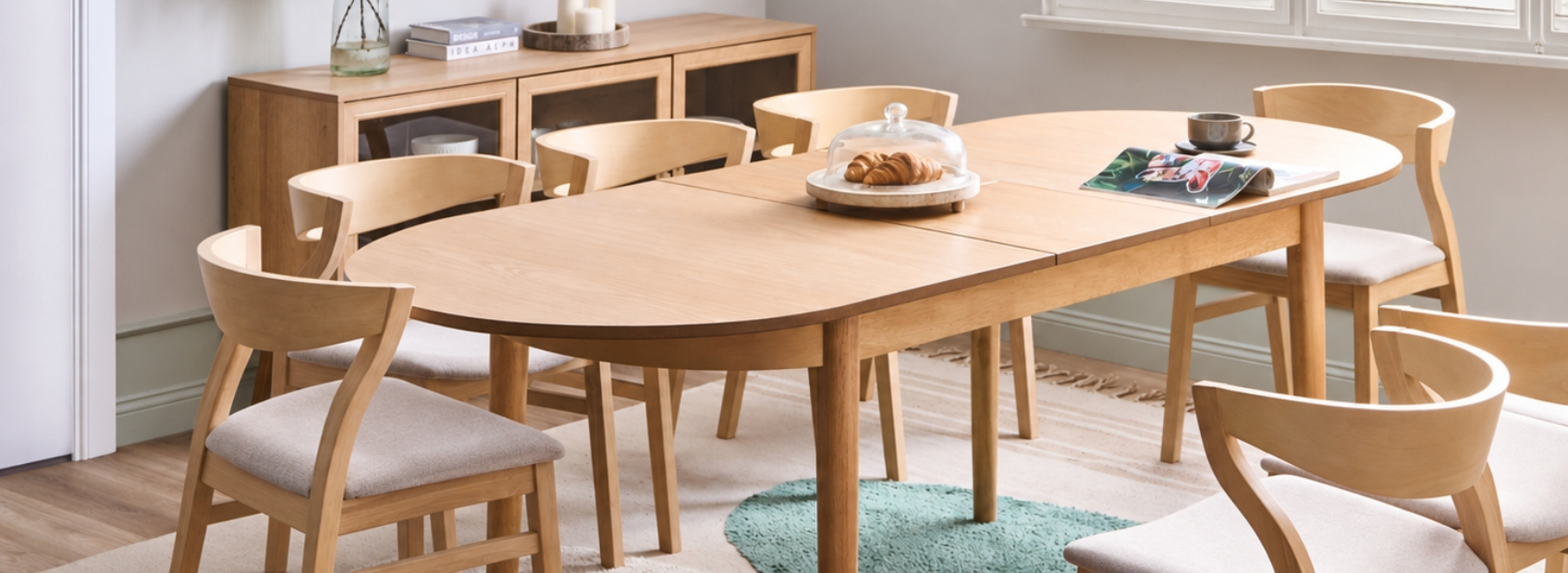
Flick between the two sizes to see how an extendable dining table keeps up with your day.
Hosting
Extended for guests
8 seats
Open it up for family dinners, birthdays and Christmas lunch. When the last guest has gone home, simply slide it back to its everyday size.
How do extendable dining tables actually extend?
Extendable dining tables add length in a handful of different ways. The mechanism affects how much effort it takes to open the table and where the spare leaf lives when it's not in use.
Opens in the middle
Butterfly leaf
Pull the two halves of the tabletop apart and a folded leaf unfolds from underneath to fill the gap. It lives inside the table, so there's nothing to store and extending takes seconds. The easiest option if you extend your table often.
Opens at the ends
Pull-out (draw-leaf)
The tabletop stays in one piece, with extra leaves hidden underneath. Simply pull a leaf out from the end and it slides into place, level with the rest of the table. There's nothing to lift or store, though the tabletop is slightly thicker to make room for the leaves.
Compact when folded
Drop-leaf
Hinged flaps along one or both sides fold down against the legs when you don't need them. It generally adds less table surface than other mechanisms, so it suits a table that spends most of its life at its smaller size.
Classic
Separate removable leaf
One or more loose leaves are kept elsewhere and dropped in by hand once the table is pulled apart. It's a simple mechanism that can add more length than a butterfly leaf, but it often needs a second person and a handy storage spot.
Check how far the table needs to be pulled away from the wall
A pull-out mechanism needs its full-length rails to slide, so the table has to be pulled clear of any wall behind it before it will open fully. If the table's usual spot is close to a wall, measure that clearance before you buy.
How much space does an extendable dining table need?
Work out how much floor space the table needs at both sizes. As a rule of thumb, allow around 60 cm of table edge per seated guest. That's the standard place-setting width in most dining table sizing guides. You can squeeze down to 50 cm at a pinch, or go up to 70 cm if you'd like more elbow room.
Leave at least 90 cm of clear floor space between the table edge and the nearest wall or furniture on every side, so chairs can be pulled out and guests can sit down and get up without an awkward shuffle. If the gap also doubles as a walkway while others are seated, allow around 120 cm.
Which material suits a table that's extended often?
The tabletop material affects how the table looks at both sizes, and how much upkeep it needs, from a quiet weeknight to a table full of guests.
| Material | Look and feel | Care | Best for |
|---|---|---|---|
| Solid wood | Natural grain that varies slightly from piece to piece and deepens in tone over the years. | Wipe with a soft, slightly damp cloth, put a mat or coaster under hot dishes and keep it out of prolonged direct sunlight. | Stands up to daily wear and ages gracefully, so it suits a table that's regularly extended to full length. |
| Wood veneer | A thin layer of real wood over a very stable core, so the top stays flatter than solid wood when humidity changes. | Wipe clean, avoid soaking the surface and don't drag rough objects across it, as the veneer layer is thin. | Keeps the leaf and the main tabletop sitting flush, even as the room's humidity changes through the year. |
| Paper veneer | A printed paper layer sealed under a protective coating, giving a wood-look finish without real wood grain underneath. | Wipe with a dry or lightly damp cloth, and avoid soaking the surface, since moisture can lift the paper layer at the seams over time. | Matching a wood look across a large extending surface at a lower cost than real wood veneer. |
| Tempered glass | A smooth, reflective surface that makes a small room feel more open and shows off the frame beneath. | Clean with glass cleaner or a damp cloth, avoid abrasive scourers and use placemats to cut down on fingerprints and scratches. | Brightens a compact dining area and pairs best with a slim, modern frame rather than a heavy, traditional base. |
| Painted | A solid, opaque colour applied over a wood or MDF base, giving a clean, uniform look rather than visible wood grain. | Wipe with a soft, damp cloth and avoid abrasive cleaners, which can dull or scratch the painted surface over time. | A bold or pastel colour statement that also hides the join line between the tabletop and the leaf. |
| Lacquered | A hard, glossy or matte topcoat applied over wood or MDF, sealing the surface and adding extra shine or depth. | Wipe with a soft cloth, avoid abrasive pads, which can scratch the lacquer, and use coasters to prevent heat marks. | A polished, high-shine look that resists moisture well, suiting a more formal dining setup. |
| Laminate | A tough, printed surface that can mimic wood, stone or a solid colour at a lower price than the real thing. | Wipe with a damp cloth. It resists stains and scratches well, but it can't be sanded or refinished if it gets damaged. | Shrugs off spills, scratches and busy family life, with very little upkeep between hosting occasions. |
Shop now: dining table sets
Choosing chairs for an extendable dining table
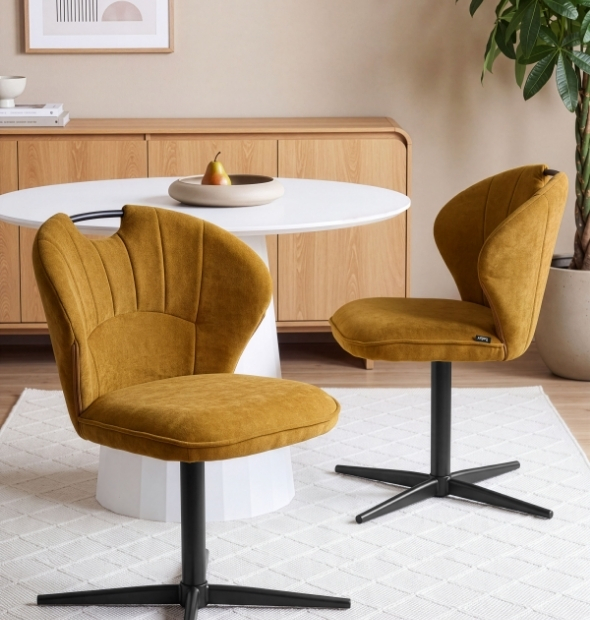
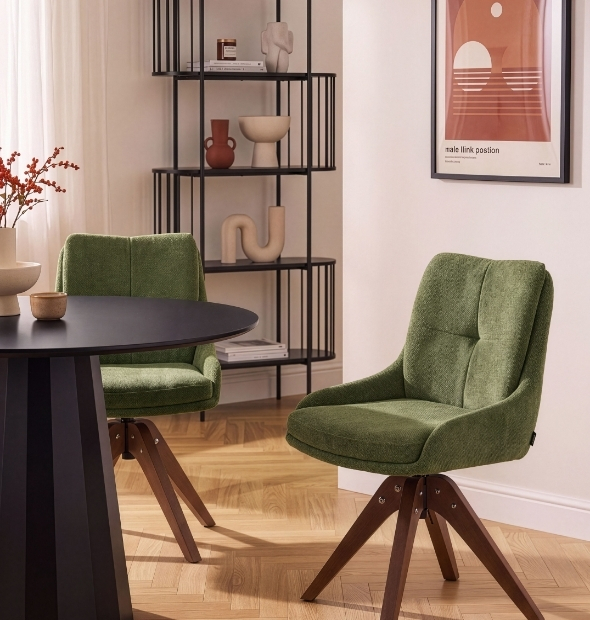
Shop the look
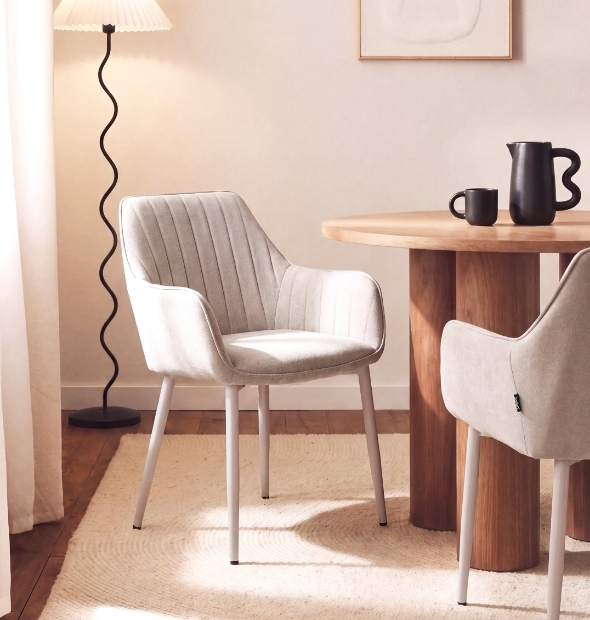
Matching chair height to the table
Most dining tables stand 71 to 76 cm high, but the figure that really matters is the gap between chair and table, not the table height on its own. Aim for around 25 to 30 cm between the chair seat and the underside of the tabletop, so there's room for your knees and the chair still tucks in fully.
This clearance doesn't change when the table is extended, because the tabletop height stays the same at any length. What does change is how many chairs you need, so check that any extra ones match the seat height of your everyday set, even if the style is different.
Shop now: dining chairs
Styling for everyday use and hosting
A table that grows for guests doesn't need a matching set of extra chairs gathering dust for the rest of the year. Folding chairs, stacking chairs or a bench kept elsewhere can fill the extra length on the few occasions you need it, while your everyday chairs stay put.
Mixing chair styles around one table works well when a shared detail ties them together, such as the same leg material, a similar seat height or two tones of the same colour. A bench along one long side is also a smart match for an extendable table: it seats more people per metre than individual chairs and doesn't need its own storage space.
Upholstery is worth thinking about too, depending on how often the table is used at full size. A wipeable material copes better if you're regularly feeding a crowd, while a softer fabric suits chairs that mostly see quiet weeknight use.
Read more: finding the perfect dining room chair
Will it fit? Check before you buy
An extendable table needs space in two sizes, so work through these checks with a tape measure before you commit to one.
-
Measure the space for the closed table
Measure the length and width of the spot where the table will usually live, then compare it with the table's closed size.
-
Measure the space for the extended table
Check that the table's full extended length fits and that there's still room to walk around it.
-
Leave space for the chairs
Chairs need room to be pulled out and pushed back. Check there's enough space on every side where people will sit.
-
Check doors, radiators and sockets
Make sure nothing gets in the way when the table is extended, such as a door that swings into the room, a radiator or a floor socket.
-
Plan where the spare leaf will go
If your table has a separate leaf, decide where it will live when it's not in use, such as in a wardrobe or under a bed.
Shop now: extendable dining tables
Frequently asked questions
Can one person open an extendable table alone?
Usually, yes. Most extendable tables are designed for one person to operate, especially butterfly-leaf and pull-out mechanisms, where you simply pull the tabletop apart. Tables with a separate leaf to lift and insert are easier with two people, mainly to keep the leaf aligned as it's lowered into place.
Will the extension leaf still match the rest of the table as it ages?
The leaf is usually made in the same production batch as the rest of the tabletop, so the colour and grain match closely when the table is new. Solid wood can develop slightly different tones over time if the leaf spends most of its life stored away from light, since wood keeps changing colour with exposure to daylight.
Does extending a table reduce how much weight it can hold?
A well-built extendable table is designed to carry a full table setting at any length, so extending it doesn't meaningfully reduce the weight it can hold for everyday dining. The main difference is support at the centre: tables with a single central leg or pedestal sometimes include a drop-down support leg that you need to use once the table is extended.
Can a leaf be added to a table that didn't originally come with one?
Usually not. Extension leaves are made to match the exact width, thickness and finish of one specific table, so a leaf can't normally be added afterwards or swapped between models. If you might need extra length later, it's simpler to choose an extendable model from the start, even if it stays closed most of the time.