
 Free Delivery & Return
 365-Day Returns
 10 Million Happy Customers
 500,000 Products in Stock


Toilets


Toilets
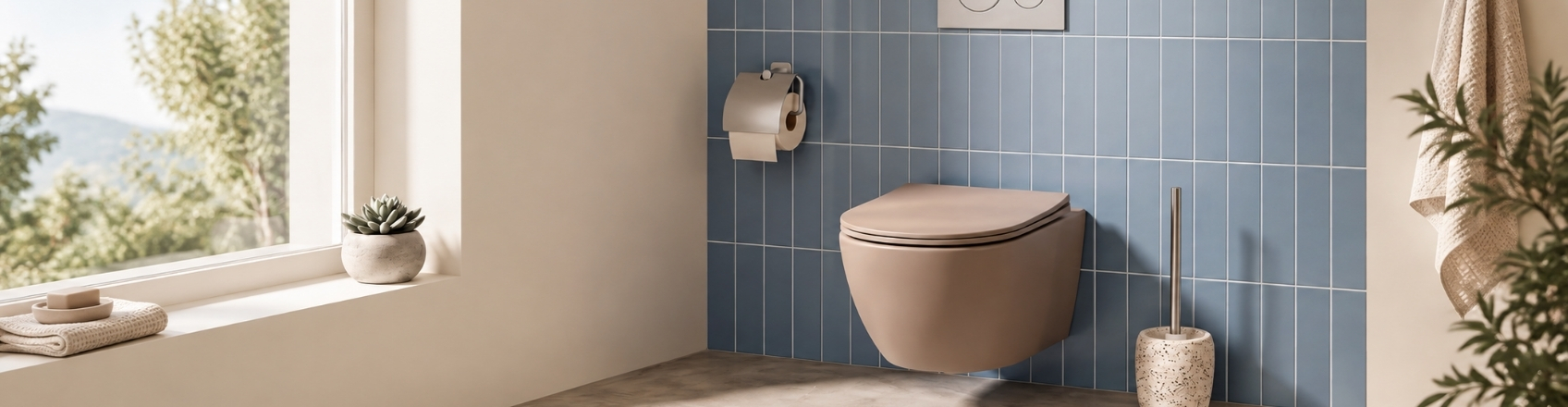
A toilet might be the most-used fixture in any home, yet it's usually the last thing people research properly before buying one. The type you choose affects how it's installed, how easy it is to keep clean, and whether it will fit your existing plumbing without extra building work. This guide sets out the main toilet types and the practical features worth checking before you decide.
What are the different installation types of toilet?
Close-coupled
A close-coupled toilet has the cistern bolted straight onto the back of the pan, forming a single unit that fits onto almost any existing plumbing. Because the cistern and flush mechanism sit in the open, repairs and parts replacement are usually straightforward. It's typically the most affordable option and the easiest type to swap like-for-like when replacing an old toilet.
Back-to-wall
A back-to-wall toilet conceals the cistern inside a wall-hung furniture unit or a false wall, so only the pan is visible in the room. This gives a cleaner look and a base that's easier to wipe around than an exposed cistern. It does need the furniture unit or false wall built and plumbed in before tiling, so it suits a full bathroom renovation rather than a direct swap.
Wall-hung
A wall-hung toilet fixes the pan directly to the wall using a concealed frame bolted into the wall or floor, with the cistern hidden inside that frame. Leaving the floor completely clear makes the whole room easier to mop and can make a small bathroom feel more open. Because the frame has to be fitted and tiled around, it's realistically a renovation choice rather than something fitted in an afternoon.
Corner toilet
A corner toilet has a cistern designed to tuck into the corner of the room, with the pan projecting forward as usual. It frees up wall space elsewhere in a small or awkwardly shaped bathroom. The trade-off is a smaller range of pan shapes and cistern styles to choose from compared with a standard close-coupled model.
What's the difference between a one-piece and a two-piece toilet?
What's the difference between a P-trap and an S-trap toilet?
This refers to where the waste outlet sits on the pan. A P-trap, or horizontal outlet, connects to a pipe that exits through the wall behind the toilet. An S-trap, or vertical outlet, connects to a pipe that exits down through the floor. Always match this to your existing plumbing: choosing the wrong outlet type means moving pipework, which adds real cost and disruption to what should be a simple swap.
What is a rimless toilet, and why does it matter?
A rimless pan removes the hidden rim under the bowl's edge found on older toilet designs, so water sweeps down an open channel instead of through a concealed lip. That hidden rim is exactly where limescale and bacteria used to build up out of sight. Rimless design has become close to standard on newly designed toilets because it noticeably cuts down on how often and how hard you need to scrub.
How does a dual-flush toilet work, and how much water does it use?
A dual-flush cistern has two buttons: a reduced flush for liquid waste and a full flush for solid waste. A common split is around 3 litres for the reduced flush and 6 litres for the full flush, though many newer models use less to meet tighter water-efficiency standards. Older single-flush toilets could use as much as 12 to 13 litres with every flush, so switching to a dual-flush model makes a real difference to a household's water use over a year.
What is comfort height, and do I need it?
A standard toilet pan sits at roughly 40 cm from the floor to the seat. A comfort-height, or raised-height, model adds around 5 to 6 cm, bringing the seat closer to the height of a dining chair. The extra height makes sitting down and standing up noticeably easier, which suits taller adults, anyone with knee or hip discomfort, and bathrooms shared by people of different heights.
What should you check before buying a toilet?
Work through these checks before you order, in the order they'll actually come up.
- Confirm whether your current waste pipe exits through the wall or the floor, and buy an outlet type (P-trap or S-trap) that matches it
- Measure the pan's width and projection against the available floor space, especially in a smaller bathroom
- Decide on installation style early: close-coupled or back-to-wall suits a straightforward swap, while wall-hung needs a concealed frame built in before tiling
- Check whether the pan is rimless and the seat is soft-close, since these affect daily cleaning more than almost any other spec
- Compare flush volumes: a dual-flush model with a clearly lower reduced-flush option will use noticeably less water over time
- Consider a comfort-height model if anyone in the household finds standard seat height hard to use